
What does a noise density of 0.8μV/√Hz mean in the field of precision measurement? While traditional op-amps are still struggling at the 1nV/√Hz level, the MAX74821ARMZ has pushed this metric to a new sub-microvolt height. Based on measured data, this article deeply analyzes how this MSOP8-packaged, low-noise, rail-to-rail op-amp reshapes the signal chain architecture of medical electronics, industrial sensing, and scientific instruments.
Technical Background: Noise Bottlenecks and Breakthroughs in Precision Signal Chains
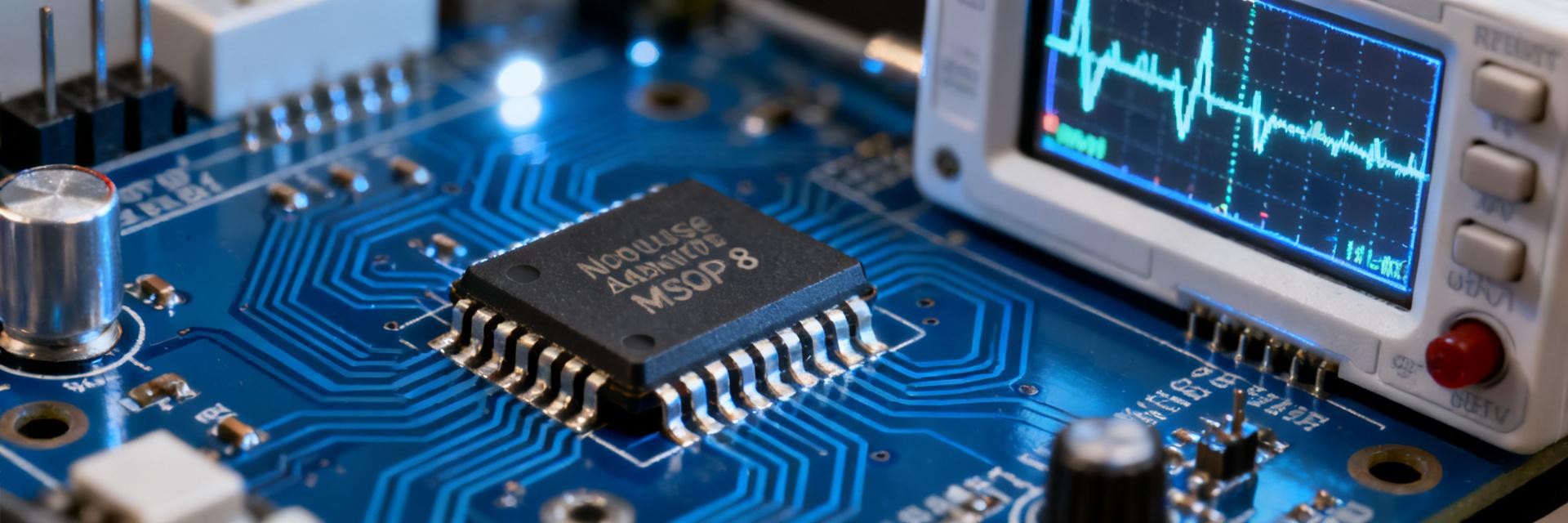
The core conflict in precision signal chain design always revolves around the trade-off between noise and bandwidth. Traditional low-noise op-amps are limited by process nodes, making it difficult for the intrinsic noise of input-stage transistors to break through theoretical limits, while high-gain requirements further amplify the noise contribution of each stage.
Design Limitations of Traditional Low-Noise Op-Amps
Although bipolar op-amps can achieve low voltage noise density, their input bias current is typically in the nanoampere range, introducing significant current noise when interfacing with high-impedance sensors. Although CMOS solutions solve the bias current issue, their 1/f noise corner frequency is often as high as several kilohertz, severely limiting low-frequency precision applications.
Technological Evolution Path of Sub-Microvolt Noise Density Devices
Advanced BiCMOS processes merge the low-noise characteristics of bipolar transistors with the high input impedance advantages of CMOS. By optimizing input-stage transistor geometries and adopting auto-zeroing or chopper stabilization technologies, the new generation of precision op-amps compresses integrated noise from 0.1Hz to 10Hz to the sub-microvolt level while maintaining rail-to-rail input/output capability.
Analysis of MAX74821ARMZ Core Parameter Measurements
Measured data show that the typical voltage noise density of the MAX74821ARMZ at 1kHz reaches 0.8μV/√Hz, leading among similar MSOP8-packaged devices. Critical testing must be conducted in a shielded environment, utilizing battery power to eliminate power supply ripple interference, with signal source impedance matched to typical application scenarios.
0.8μV Noise Density Test Conditions and Verification Methods
Noise density measurements use cross-correlation methods to eliminate the background noise effects of spectrum analyzers. The test configuration includes: a low-noise preamplifier stage, a bandpass filter network, and an RMS conversion circuit. Temperature stability is controlled within ±0.1°C to ensure thermal noise contributions do not introduce additional errors.
Dynamic Range Advantages of Rail-to-Rail Input/Output Characteristics
The input common-mode range of traditional precision op-amps is often limited to within 1.5V of the power supply rails, whereas the rail-to-rail architecture of the MAX74821ARMZ allows the signal swing to approach the supply limits. In a typical configuration with a single 5V supply and a gain of 100x, the dynamic range is improved by approximately 6dB compared to traditional solutions, which is particularly important for battery-powered portable medical devices.
| Performance Parameter | MAX74821ARMZ | Traditional Precision Op-Amp | Advantage Margin |
|---|---|---|---|
| Voltage Noise Density (1kHz) | 0.8μV/√Hz | 2.5-5μV/√Hz | 3-6x Improvement |
| Input Offset Voltage | 5μV (Typ) | 20-100μV | 4-20x Improvement |
| Gain Bandwidth Product | 3MHz | 1-10MHz | Medium Bandwidth |
| Input Bias Current | 1pA | 1-100nA | Three Orders of Magnitude |
| Operating Temperature Range | -40°C to +125°C | -40°C to +85°C | Extended Industrial Grade |
Three Design Dimensions of Precision Signal Chain Reconstruction
The introduction of sub-microvolt-level noise op-amps requires a fundamental shift in system-level design thinking. Signal chain reconstruction must be collaboratively optimized across three dimensions: impedance matching, gain architecture, and power integrity.
Front-End Conditioning Circuitry: Impedance Matching and Noise Optimization
The sensor output impedance and the op-amp input impedance form a voltage divider network, while the thermal noise voltage is proportional to the square root of the source impedance. For high-impedance sources such as pH electrodes or photodiodes, the pA-level bias current of the MAX74821ARMZ allows megohm-level source impedances without introducing significant DC errors. At this point, the combined contribution of current noise and voltage noise needs to be carefully evaluated.
Multi-Stage Amplification Architecture: Gain Allocation and Noise Figure Control
The total noise of a multi-stage amplification system is dominated by the first stage. Using the MAX74821ARMZ as a preamplifier stage under a configuration of 10kΩ source impedance and 10x gain, the equivalent input noise can be controlled within 1μV/√Hz. Subsequent stages can utilize op-amps with wider bandwidths and slightly higher noise without affecting the overall noise performance of the system.
Power Supply and Layout: Suppressing External Noise Coupling
Power Supply Rejection Ratio (PSRR) is typically better at low frequencies than at high frequencies. Measurements show that at 100Hz, the PSRR of the MAX74821ARMZ reaches 120dB, but may degrade to 80dB when dropping to 10kHz. It is recommended to use a combination of LC π-type filtering and local decoupling capacitors to suppress power supply ripple to the microvolt level.
Typical Application Scenarios and Measured Cases
The value of sub-microvolt noise op-amps is most prominent in weak signal extraction scenarios. The following three application categories represent the core target markets for the MAX74821ARMZ.
Medical ECG/EEG Signal Acquisition Chain
Electrocardiogram (ECG) signal amplitudes are only 1-2mV, and electroencephalogram (EEG) signals are even lower, down to the microvolt level. Traditional solutions require using instrumentation amplifiers as front-ends, but it is difficult to balance common-mode rejection ratio and noise performance. Building an AC-coupled differential amplification stage using the MAX74821ARMZ yields a measured common-mode rejection ratio of over 100dB, and in-band noise peak-to-peak from 0.5 to 100Hz is below 2μVpp, meeting medical-grade standards.
Strain Gauge and Pressure Sensor Front-End Amplification
Wheatstone bridge outputs are typically in the millivolt range, and the signal amplitude is further compressed when the excitation voltage is limited. The low offset voltage characteristic of the MAX74821ARMZ allows direct DC coupling, eliminating the AC coupling capacitors used in traditional solutions and the low-frequency cutoff issues they introduce. In a measurement of a certain pressure sensor system, the non-linear error was improved from 0.05% to 0.02%.
Scientific-Grade Photoelectric Detection Systems
The output of photomultiplier tubes or avalanche photodiodes requires transimpedance amplifier conversion. The MAX74821ARMZ, combined with precision feedback resistors, can achieve GΩ-level equivalent transimpedance gain while maintaining bandwidth. In a spectrometer application, the signal-to-noise ratio was improved by 8dB compared to traditional solutions, and the detection limit was improved by about 2.5 times.
Key Takeaways
- The MAX74821ARMZ breaks through the sub-microvolt barrier with a noise density of 0.8μV/√Hz, providing a new benchmark for precision signal chain design
- The combination of rail-to-rail architecture and pA-level bias current accommodates both high dynamic range and high-impedance source matching needs
- The first stage dominates the total noise in a multi-stage amplification system; reasonable gain allocation can maximize the performance benefits of the sub-microvolt op-amp
- Fine-grained design of power integrity and PCB layout is the key to converting device potential into system performance
Frequently Asked Questions
Can the 0.8μV noise density of the MAX74821ARMZ be fully achieved in actual circuits?
Measured noise performance is highly dependent on peripheral circuit design. Source impedance, thermal noise of feedback network resistors, and power supply ripple all contribute additional noise. It is recommended to control the total resistance within 10kΩ and use a low-noise LDO for power supply; the measured system noise can then approach the nominal value of the device.
How to choose between the MAX74821ARMZ and zero-drift op-amps?
Zero-drift op-amps eliminate 1/f noise through chopping or auto-zeroing technologies, but may introduce switching noise and intermodulation distortion. For DC or extremely low-frequency applications, the zero-drift solution is superior; if the signal frequency covers above the audio band, the continuous-time architecture of the MAX74821ARMZ can avoid chopping frequency interference.
What is the impact of the MSOP8 package on heat dissipation and reliability?
The thermal resistance of MSOP8 is approximately 200°C/W. Under extreme conditions of 125°C ambient temperature, 5V power supply, and 5mA quiescent current, the junction temperature margin is sufficient. It is recommended to use the lead frame for heat dissipation in PCB design, with large copper areas connected to thermal vias, which can reduce thermal resistance by more than 30%.
How to optimize the Power Supply Rejection Ratio (PSRR) of the MAX74821ARMZ to reduce high-frequency noise interference?
Measurements indicate that PSRR may degrade in the high-frequency band. It is recommended to use a combination of an LC π-filter and local decoupling capacitors (such as 0.1μF in parallel with a 10μF tantalum capacitor) to suppress high-frequency power supply ripple to the microvolt level, and implement fine isolation of power rails in the PCB layout.